Routine Flaring Is a Symptom, Not the Root Cause: Flare Performance and Unit Operation in LNG Plants
Routine flaring at an LNG plant is usually a symptom, not the root cause—the flare is telling you something about process control, equipment performance, and unit operation upstream of it. That is how the engineers at Alaska LNG Services LLC read a flare, and it changes where you look for the fix.
The flare itself is a critical safety system: it safely combusts hydrocarbons during start-up, shutdown, process upsets, and emergency pressure relief. No plant runs without one. But every tonne burned in routine operation is lost product, added operating cost, and avoidable emissions—so effective unit operation minimizes routine (quiescent) flaring while keeping the full protective function intact.
Flaring Starts Upstream
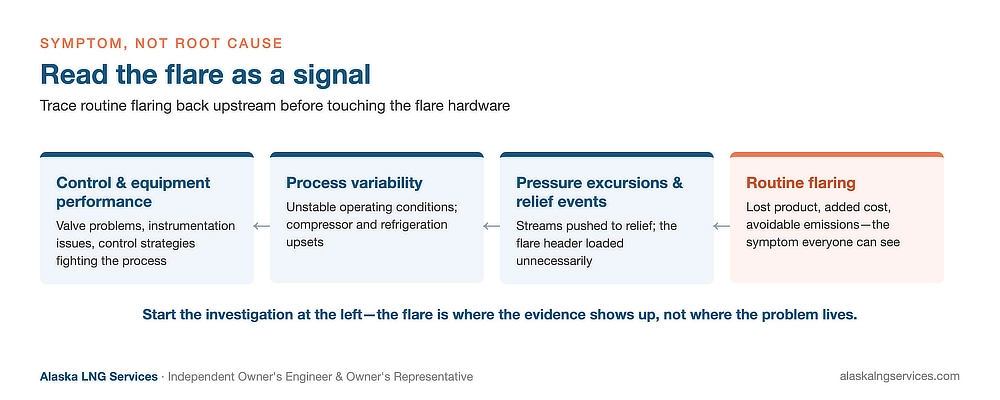
Modern LNG facilities are designed for minimal continuous flaring—so when routine flaring creeps up, the cause is rarely the flare. The usual contributors sit upstream: poor process control performance, unstable operating conditions, compressor and refrigeration upsets, control strategies that fight the process, valve and instrumentation problems, and unit interactions that load the flare header unnecessarily.
| The flare problem you see | The upstream cause to check first |
|---|---|
| Routine flaring volumes creeping up | Process variability and pressure excursions pushing streams to relief |
| Frequent relief events | Compressor or refrigeration instability; control strategies fighting the process |
| Smoke and incomplete combustion | Gas composition and rates outside what the tip was designed to burn cleanly |
| Flare tip damage and structural deterioration | Prolonged or high-magnitude flaring driving radiative heat flux beyond the metallurgy |
| Back-burning at the tip | Exit velocities and purge gas rates below design minimums |
| Back-pressure alarms during flaring events | Flare system design not coordinated with the process units’ operating pressure windows |
Reducing flare frequency and magnitude therefore usually begins with plant stability, not flare hardware. This is the same principle behind our work on process control performance in LNG facilities: tighter control means fewer pressure excursions, fewer relief events, and less gas reaching the header in the first place.
Venting, Flaring, and Not Releasing at All
The environmental hierarchy is worth stating precisely, because the raw numbers drive it. Methane has a Global Warming Potential (GWP) of 27 to 30 times that of CO2 over 100 years—and 81 to 83 times over 20 years, per the U.S. Environmental Protection Agency (EPA). That is why flaring—which combusts methane to CO2 and water—is environmentally preferable to the venting some older, non-LNG facilities historically practiced. A visible flame is not aesthetically desirable, but oxidation beats release.
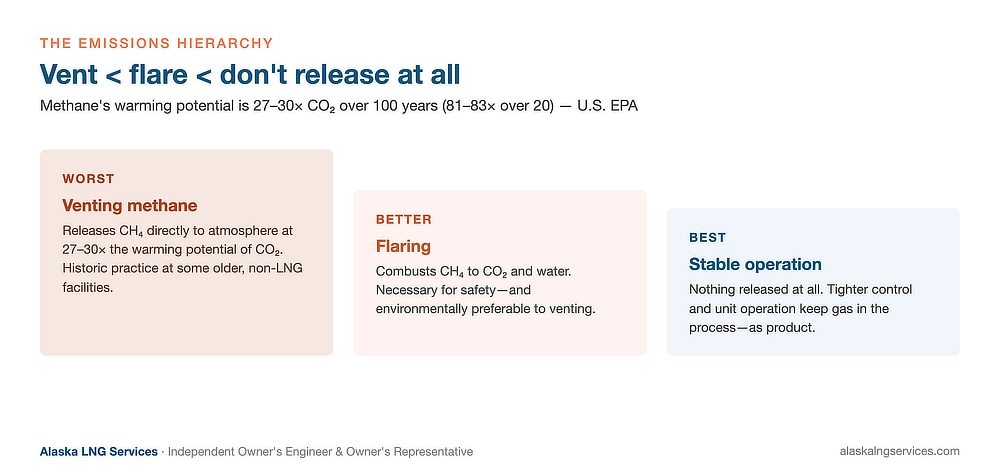
The best outcome, though, sits above both: stable operation that avoids the release altogether. That is where flaring reduction, production efficiency, fuel savings, and emissions performance all converge on the same engineering work.
The World Is Watching
Flaring is no longer only an operations metric—it is a governance one. The World Bank’s Zero Routine Flaring by 2030 initiative, launched in 2015, now carries endorsements from 36 governments and 60 oil companies committed to ending routine flaring—yet global flaring rose for a third consecutive year in 2025 to 167 billion cubic meters, the highest level since 2019. Investors, regulators, and communities read flare performance as a proxy for how well a facility is run—because, as this article argues, that is exactly what it is.
The Flare System Itself Is Not Trivial
None of this diminishes the flare design problem. A flare must perform across a wide, dynamic envelope, and the design variables interact: gas composition, flow rate, pressure, and temperature; molecular weight and heating value; tip exit velocities; minimum purge rates to prevent back-burning; wind and ambient effects on boundary oxidation; radiation limits; stack configuration, tip count, and plant layout. Prolonged radiative heat flux drives thermally accelerated metallurgical degradation at the tip—which is why demanding services end up in expensive nickel superalloys to hold integrity and combustion performance.
And all of it must be balanced against the process units’ back-pressure limits, so that the system protecting the plant from overpressure never becomes the constraint that violates an operating pressure window.
Where the Gains Are
The highest-return flaring work our engineers see is rarely a new flare tip. It is upstream: reducing process variability, stabilizing compressors, fixing the valve and instrumentation problems that drive excursions, and aligning control strategy with how the units actually run. The same improvements that cut flaring also raise production, cut fuel consumption, and improve availability—the win-win the environmental and commercial cases share.
That work runs through our process plant performance engineering and the field engineering and operational troubleshooting that takes findings from analysis to implementation—independent, owner-side, with no flare hardware to sell.
Alaska LNG Services provides independent Owner’s Engineer and Owner’s Representative services across process plant and marine LNG facilities. Contact us to discuss your plant.
Frequently Asked Questions
Why do LNG plants flare at all?
The flare is the plant’s ultimate pressure-relief safeguard: during start-up, shutdown, upsets, and emergencies, it safely combusts hydrocarbons that would otherwise overpressure equipment or be released unburned. The goal of good unit operation is not to eliminate the flare—it is to make routine use of it rare.
Is flaring better than venting?
Yes, decisively. Venting releases methane directly, and methane’s warming potential is 27 to 30 times that of CO2 over 100 years (81 to 83 times over 20 years, per the EPA). Flaring combusts methane to CO2 and water, which is the environmentally better outcome—though stable operation that avoids the release entirely beats both.
What is routine (quiescent) flaring, and what is Zero Routine Flaring by 2030?
Routine flaring is combustion of gas during normal operations—not upsets or emergencies—and it represents continuous product loss and emissions. Zero Routine Flaring by 2030 is a World Bank initiative, launched in 2015 and endorsed by dozens of governments and oil companies, committing endorsers to end routine flaring no later than 2030.
What causes a smoking flare or flare tip damage?
Smoke means incomplete combustion—typically gas composition, rates, or exit velocities outside what the tip was designed to burn cleanly. Tip damage is usually thermal: prolonged or high-magnitude flaring drives radiative heat flux that degrades the metallurgy, which is why demanding flare services specify nickel superalloys. Both are frequently symptoms of upstream operating patterns rather than one-off flare defects.
You can learn more in our Alaska LNG engineering articles.