Joule-Thomson Valves and Expanders: The LNG Production Capacity Hiding in Plain Sight
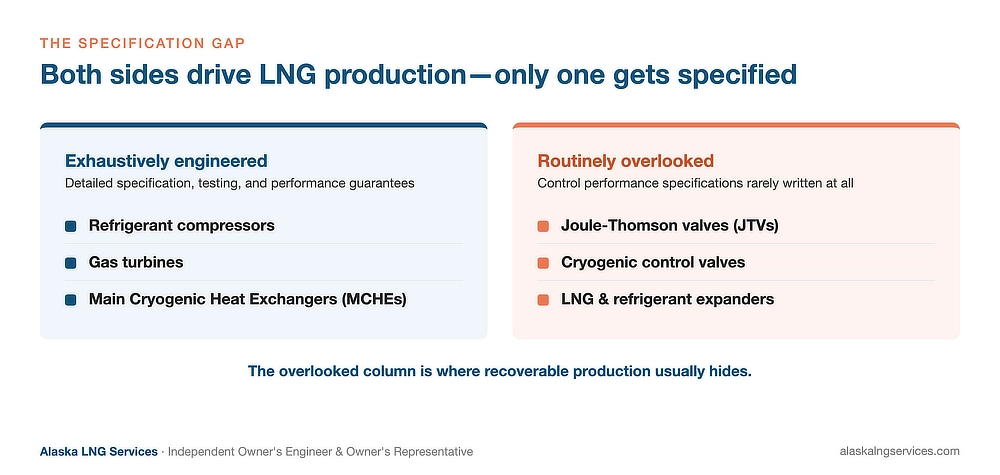
Many LNG plants are leaving production on the table because Joule-Thomson valve (JTV) and expander performance problems have been quietly accepted as normal. Compressors, gas turbines, and Main Cryogenic Heat Exchangers (MCHEs) receive exhaustive specification and performance testing—while the valves and expanders equally critical to production are rarely scrutinized at all. That asymmetry is where the engineers at Alaska LNG Services LLC have repeatedly found recoverable capacity.
The physics is unforgiving of imprecision. A liquefied natural gas (LNG) plant removes vast quantities of heat through cryogenic refrigeration, and JTVs do critical work through the Joule-Thomson effect—the temperature drop a real gas undergoes when throttled across a valve. The energy stakes are large: per the U.S. Energy Information Administration (EIA), roughly 7% to 15% of LNG feed gas is consumed by the liquefaction process itself, mostly running the refrigeration equipment. Control performance that wastes compressor power is burning margin—and adding emissions—around the clock.
The Equipment Nobody Specifies
Extensive engineering effort goes into specifying rotating equipment and heat exchangers. Yet the industry routinely omits control performance specifications for control valves—including the JTVs at the heart of the refrigeration cycle. The consequences are well documented in the process-control literature: deadband, stiction, positioner overshoot, oversizing, and nonlinear flow characteristics each degrade loop performance, and several of them produce sustained oscillations that ripple through the entire refrigeration train.
| The valve or expander problem | What it costs the plant |
|---|---|
| Deadband (mechanical backlash) | Sustained oscillations in the loop; process variability that propagates through the refrigeration cycle |
| Stiction (the valve sticks, then jumps) | Stick-slip cycling the controller cannot tune out; premature valve and trim wear |
| Oversized valves working at small openings | Amplified positioning errors; coarse control where the process needs fine adjustment |
| Nonlinear flow characteristics | Loops that are stable at one rate and unstable at another; operators detune to cope |
| No control performance specification at purchase | All of the above arrive built-in—and are discovered, if ever, in operation |
Process control engineers and technologists who see these symptoms daily may accept them as the plant’s personality. Without specialist forensic knowledge, a solvable problem is assumed to be a fixed constraint—and the opportunity stays invisible for the life of the facility.
Variance Is the Enemy of Capacity
Every plant operates against real constraints—compressor power, exchanger approach temperatures, product specifications. But no plant operates at its constraints; it operates at a safe distance from them, and the size of that distance is set by process variability. The noisier the control, the further from the true limit the plant must run.
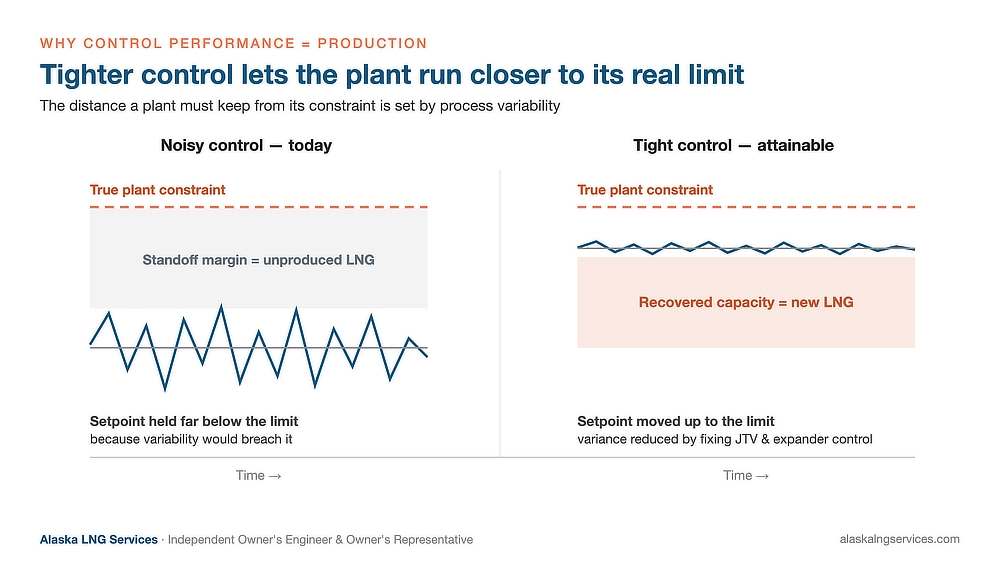
That is why variance reduction converts directly into production: tighten JTV and expander control, and the operating point can move closer to the real constraint more of the time. In our engineers’ experience, the benefit is roughly inversely proportional to the variance—cut the variability in half, and the recovered operating margin becomes new LNG.
Process Control Is More Than the DCS
Capturing that margin is not simply loop tuning or an Advanced Process Control (APC) layer. APC itself is frequently limited by the valve dynamics underneath it—an APC application commanding a sticking JTV is optimizing a fiction. Real optimization requires the disciplines to work as one system: process engineering, process control, instrumentation, cryogenic equipment design, refrigeration thermodynamics, plant economics, and operations. Refrigerant mixture composition belongs on the same list—optimized with first-principles engineering and reconciled against empirical, statistical operating data, because real plants deviate from their models.
The Business Case
Every improvement should be quantified before it is pursued: current versus technically attainable performance, the LNG production delta, compressor energy and fuel-gas savings, emissions reduction, and the resulting return on investment (ROI). In our engineers’ experience across global LNG projects, JTV and expander control improvements commonly pay back in 3 to 12 months. Better equipment control also mitigates the escalation of cascading trips—bringing units back to stable operation faster after an upset, which protects availability as well as efficiency.
Working With OEMs and EPCs—Without the Conflict
Our engineers have written equipment and control specifications, guided Original Equipment Manufacturers (OEMs) pragmatically, and led investigation and remediation of major project warranty claims on the owner’s behalf—resolved by evidencing to all parties what the equipment can actually do, without escalating into litigation. The repeated pattern is worth noting: engagements that begin as “a problem” end with owners, contractors, and vendors adopting the findings—and OEMs incorporating the improvements into their future offerings.
That is what independent, owner-side engineering looks like in practice: no equipment to sell, no design to defend, and the evidence to make every party better off.
Questions Worth Asking
If your LNG facility is considered maxed out, these are the questions our engineers would ask first:
- Are the JTVs, cryogenic control valves, and expanders operating at their true capability—or at what has become accepted as normal?
- Is process variability forcing operation further from the real constraints than necessary?
- Are control valve characteristics quietly limiting your APC layer?
- Is refrigerant composition optimized with both first-principles engineering and statistical reconciliation of plant data?
- Does your team have independent forensic depth in cryogenic process control to complement your vendors?
Independent cryogenic process plant engineering is where those questions get quantified answers. The control-system dimension connects to the broader challenges covered in our article on process control and automation challenges in LNG facilities, and the commercial framing—current versus attainable, and what the delta is worth—is the core of independent Owner’s Engineer support.
Alaska LNG Services provides independent Owner’s Engineer and Owner’s Representative services across process plant and marine LNG facilities. Contact us to discuss your plant.
Frequently Asked Questions
What is a Joule-Thomson valve (JTV) in an LNG plant?
A JTV is a valve that drops the pressure of a refrigerant or LNG stream, cooling it through the Joule-Thomson effect—the temperature change a real gas undergoes when throttled at constant enthalpy. In LNG service, JTVs sit at critical points in the refrigeration cycle, so their control performance directly influences production rate, efficiency, and stability.
Why do control valve problems reduce LNG production?
Problems such as deadband, stiction, and oversizing create oscillations and variability that the control system cannot tune out. Variability forces the plant to operate further from its true constraints as a safety margin—and that standoff distance is unproduced LNG. The variability also loads compressors unnecessarily, wasting fuel gas and adding emissions.
What is Advanced Process Control (APC), and why does valve performance limit it?
APC is a supervisory control layer that pushes a plant toward its economic optimum by coordinating many loops at once. APC can only be as good as the base-layer control beneath it: if the valves executing its moves stick, overshoot, or respond nonlinearly, the optimizer is acting on a plant that does not do what it is told. Fixing valve dynamics frequently unlocks more benefit than retuning the APC itself.
How quickly do JTV and expander control improvements pay back?
In our engineers’ experience across global LNG projects, typical paybacks run from 12 months down to as little as 3—because the gains come from production increase and energy reduction on equipment the plant already owns, not from new capital equipment.
You can learn more in our Alaska LNG engineering articles.