Case Study: Proving Marine Assets for Year-Round Operations in 1.2-Meter Arctic Ice
Proving marine assets can operate year-round in Arctic sea ice takes more than analytical modeling—it takes full-scale ice trials, instrumented hulls, and measured ice properties. That is how the engineers at Alaska LNG Services LLC approach cold-climate marine work, and this anonymized project from our engineers’ careers shows what the method looks like in practice.
The Challenge: A Risk Assessment Raises the Bar
A large multinational joint venture—several major international oil companies and a government partner—updated the Quantified Risk Assessment (QRA) for an offshore drilling location. The new findings required a fleet of existing marine escape craft to be modified so they could perform reliably under the project’s Safety Case.
The complicating factor was the environment. The field was ice-bound, with first-year sea ice reaching approximately 1.2 meters each winter—near the upper end of the 0.3-to-2-m`eter range that defines first-year ice, per the National Snow and Ice Data Center (NSIDC). For the operator to maintain year-round operations, the escape craft had to move through that ice effectively without becoming stranded. Emergency response capability could not be seasonal.
The Approach: Test, Don’t Assume
Analytical models alone could not carry a decision of this consequence. Instead, a series of alternative ice-breaking bow configurations was designed and fabricated, and each was validated through controlled full-scale ice trials under representative Arctic conditions—the same evidence-first philosophy behind the IMO Polar Code, which since 2017 has tied polar operation to demonstrated capability in defined first-year-ice conditions.
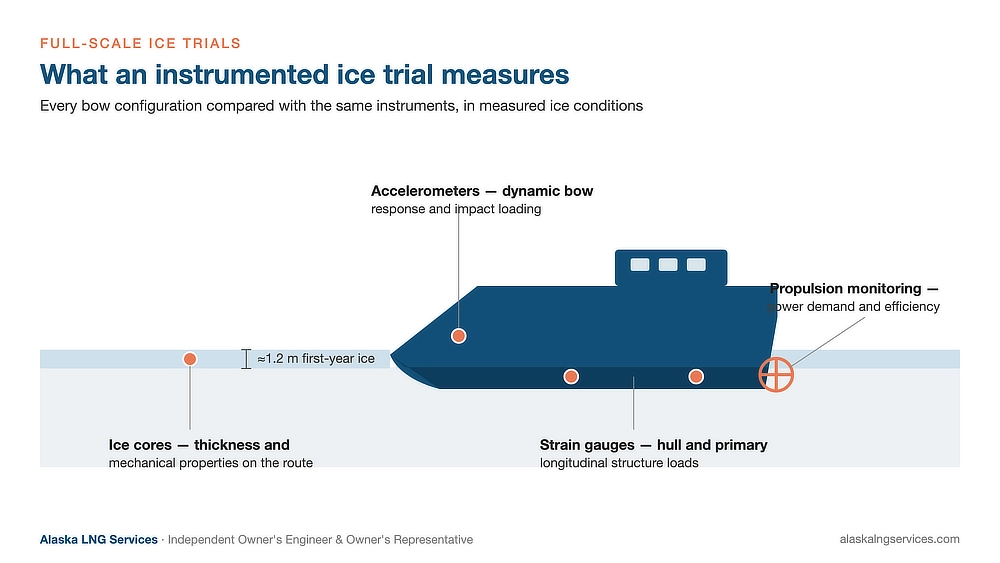
The trials assessed ice-breaking performance, vessel maneuverability, propulsion system performance, hull resistance, structural loading, and operational efficiency—each measured against the parameters set by the Safety Case.
What Was Measured—and What It Told the Engineers
| Measurement | What it told the engineers |
|---|---|
| Accelerometers on the hull | Dynamic response and impact loading of each bow configuration in real ice |
| Strain gauges on the hull and primary longitudinal structure | Actual structural loads against design limits—not estimated, measured |
| Ice core samples taken along the test route | True ice thickness and mechanical properties, so every trial run could be compared on equal terms |
| Hull resistance measurements | The ice resistance each bow geometry actually generated |
| Propulsion performance monitoring | Power demand and efficiency for each configuration under load |
Combining structural measurements with environmental data meant each bow configuration could be compared objectively—same conditions, same instruments, measured results.
From Data to a Defensible Decision
Integrating the measured ice properties, structural response, and propulsion performance identified the bow design offering the most effective balance of ice-breaking capability, structural integrity, operational reliability, propulsion efficiency, and safety performance—with the evidence to defend the selection to the operator, its joint-venture partners, and the regulator.
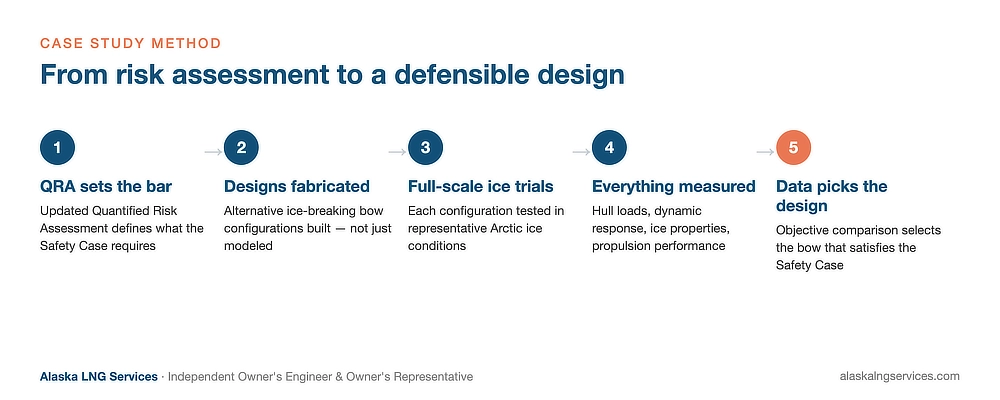
That is the difference between a recommendation and a defensible engineering decision. Offshore safety regimes are built on exactly this kind of quantified evidence—the U.S. Bureau of Safety and Environmental Enforcement (BSEE) publishes guidance on quantitative risk assessment for offshore installations for the same reason: decisions that carry life-safety consequences need measured data behind them.
Why This Matters for Project Owners
An owner facing an Arctic marine engineering decision usually hears two kinds of advice: a vendor’s assurance that its equipment will cope, or a desk study that has never touched ice. Independent, owner-side engineering is the third option—define the question the Safety Case actually asks, instrument the trial, measure the answer, and let the data pick the design.
That approach runs through all of Alaska LNG Services’ Arctic and cold-climate LNG services, and through the marine LNG systems and shipyard oversight work where vessel, interface, and facility decisions carry the same consequences. For the broader engineering picture of cold-climate projects, see our overview of Arctic LNG engineering and operational considerations.
Alaska LNG Services provides independent Owner’s Engineer and Owner’s Representative services across process plant and marine LNG facilities, including Arctic and cold-climate operations. Contact us to discuss your project.
Frequently Asked Questions
What is first-year sea ice?
First-year ice is floating sea ice of no more than one year’s growth, ranging from 0.3 to 2 meters thick per the NSIDC. It is the defining design condition for most Arctic offshore operations: thick enough to stop an unprepared vessel, yet within the operating envelope of correctly designed ice-capable craft.
What is a Quantified Risk Assessment (QRA) on an offshore project?
A QRA is a structured, numerical analysis of the risks an offshore installation and its people face—the likelihood and consequence of defined hazard scenarios. It underpins the project’s Safety Case, and when a QRA is updated with new findings, existing equipment may need to be modified and re-proven against the new requirements, as in this project.
What are ice trials?
Ice trials are full-scale tests of a vessel in real ice conditions, instrumented to measure what models can only estimate: structural loads, hull resistance, propulsion performance, and maneuverability. Ice cores taken along the test route establish the actual ice thickness and strength, so results from different runs and configurations can be compared on equal terms.
Why run full-scale trials instead of relying on modeling?
Models are only as good as their assumptions about ice behavior—which varies with temperature, salinity, age, and loading rate. For decisions with life-safety consequences, measured performance in representative conditions is the evidence a Safety Case regime expects. Modeling narrows the options; trials prove the answer.
You can learn more in our Alaska LNG engineering articles.