
Marine LNG Interfaces: Ship-to-Shore Engineering Considerations
Marine LNG Interfaces: Compatibility Is a Property of the Pair
A terminal is not compatible with a class of vessel. It is compatible, or not, with a specific ship arriving in a specific condition at a specific berth. “The berth handles 174,000 m³ carriers” is a capacity statement. Compatibility is a finding about a pair, and it has to be established pair by pair.
That distinction is the practical core of ship-to-shore interface engineering. The interface is the highest-consequence boundary in an LNG facility not because the hardware is exotic, but because it is the one place where two separately engineered, separately regulated, separately operated organizations have to function as a single system—for the twelve to twenty-four hours they are connected, every time.
Four Domains Have to Line Up
Compatibility work spans four domains, and three of them are settled long before the ship arrives.
Physical. Manifold height above the waterline across the full loaded-to-ballast range, manifold spacing and size, presentation against the loading arm layout, the arms’ working envelope and drift, drainage and drip containment, freeboard and fender geometry against the actual hull form.
Mooring and motion. Mooring analysis run for the design vessels that will actually call, environmental operating limits for wind, current, wave and—in northern ports—ice, passing-ship and surge effects in the specific channel, quick-release hook capacity, line tension monitoring, gangway reach through the tidal and draft range.
Control and ESD. The emergency shutdown hierarchy agreed across the boundary—what stops, in what order, on which signal—the ship-shore link and its physical connection, the powered emergency release and the arm’s release sequence, and cause-and-effect matrices reconciled between two control systems that were designed by different parties for different owners.
Procedural. The transfer sequence, rate, and pressures; the duties, locations, and watches of each assigned person; the working language and communication protocol; and the signed declaration that all of it has been checked.
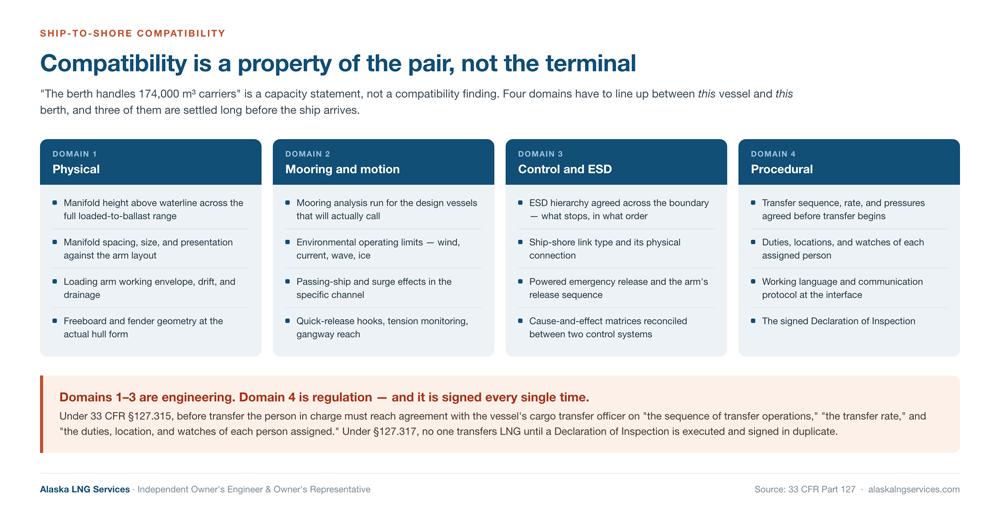
The first three are engineering deliverables. The fourth is regulated, and it is executed fresh on every single transfer.
The Interface Has Hard Numbers In It
Much of interface engineering is judgment. Some of it is not. For a U.S. waterfront facility handling LNG, the Coast Guard’s rules at 33 CFR Part 127 state values that are not open to interpretation, and they are a useful sanity check on any design or operations readiness claim.
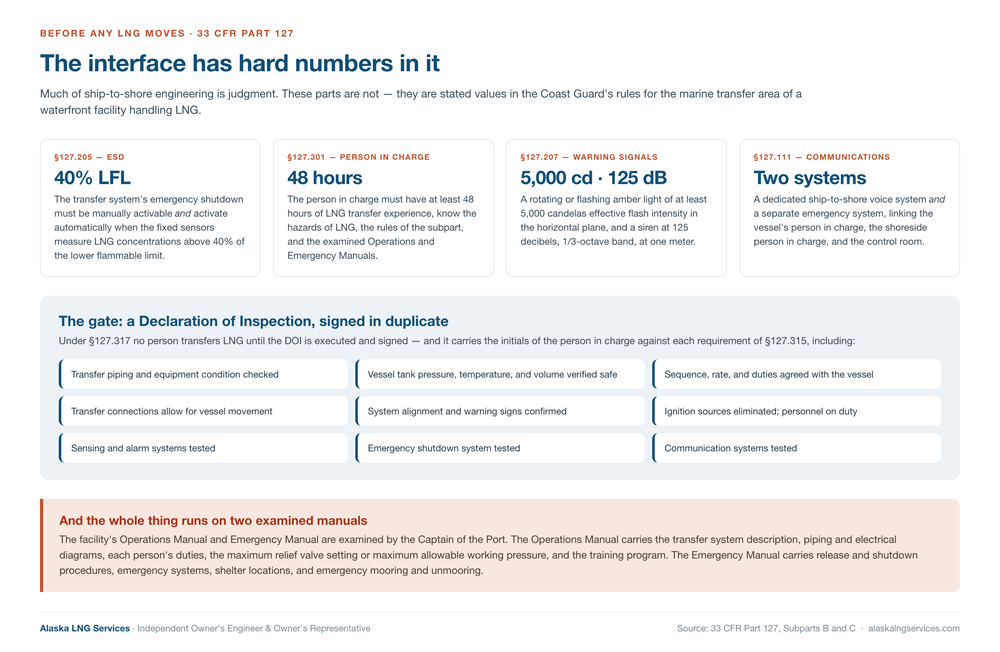
The transfer system’s emergency shutdown, under §127.205, must be manually activable and activate automatically when fixed sensors measure LNG concentrations exceeding 40% of the lower flammable limit. The marine transfer area must have a dedicated ship-to-shore voice communication system and a separate emergency system (§127.111), connecting the vessel’s person in charge, the shoreside person in charge, and the control room. Warning signals are specified down to the number: a rotating or flashing amber light of at least 5,000 candelas effective flash intensity in the horizontal plane, and a siren at 125 decibels, one-third-octave band, at one meter (§127.207). The person in charge of shoreside transfer operations must have at least 48 hours of LNG transfer experience and must know the hazards, the rules, and the examined Operations and Emergency Manuals (§127.301).
Nothing Moves Until Someone Signs
The mechanism that makes the procedural domain real is the Declaration of Inspection. Under §127.317, the person in charge of shoreside transfer operations “must ensure that no person transfers LNG until a Declaration of Inspection … is executed and signed in duplicate.” The DOI names the vessel and the facility, records the date and time transfer begins, and carries the initials of the person in charge against each requirement of §127.315—indicating that each one is met.
Section §127.315 is where the engineering and the operation meet. Before transfer, the person in charge must verify the condition of transfer piping and equipment, confirm that vessel cargo tank pressure, temperature, and volume are safe, check that transfer connections allow for vessel movement, confirm system alignment, warning signs, and elimination of ignition sources, confirm assigned personnel are on duty—and test the sensing and alarm systems, the emergency shutdown system, and the communications systems.
It also requires agreement with the vessel’s cargo transfer officer on “the sequence of transfer operations,” “the transfer rate,” and “the duties, location, and watches of each person assigned.” That is worth dwelling on. The regulation does not ask the facility to publish a transfer procedure and expect the ship to follow it. It requires the two parties to agree, before every transfer, on the sequence, the rate, and who is standing where. The interface is a negotiation with a signature on it.
Behind that sit two documents examined by the Captain of the Port: the Operations Manual—carrying the transfer system description, piping and electrical diagrams, each person’s duties, the maximum relief valve setting or maximum allowable working pressure, and the training program—and the Emergency Manual, carrying release and shutdown procedures, emergency systems, shelter locations, and emergency mooring and unmooring.
The Vessel Side Has Its Own Gate
The ship arrives with its own certification, and for owners planning a terminal’s vessel acceptance criteria, one requirement is easy to underestimate. Under 46 CFR Part 154, the Coast Guard issues an endorsed Certificate of Inspection to a U.S.-flag vessel, or an endorsed Certificate of Compliance to a foreign-flag vessel, that meets the part—and §154.150 requires that before a vessel receives an initial or reissued Certificate of Compliance endorsed with the name of a cargo, “the vessel must call at a United States port for an examination.”
A foreign-flag carrier cannot simply be nominated into a U.S. terminal on the strength of its class and its IGC certification. That is a scheduling fact as much as a regulatory one, and it belongs in the commercial model rather than in a surprise. It is the same pattern set out in our post on why class approval is not regulatory approval—the certificate you hold is not always the permission you need.
Where Interface Risk Actually Concentrates
The interface is designed once and operated thousands of times. Almost every operational limit a terminal lives with for thirty years is set by a decision taken during design or in the shipyard, when changing it costs a drawing revision rather than a berth.
That is why owner-side involvement across design, fabrication, shipyard construction, and commissioning matters more here than almost anywhere else on the project. The recurring failures are not exotic:
- A mooring analysis run for a nominal design vessel rather than for the fleet that will actually call, leaving a berth with tighter environmental limits than the commercial model assumed.
- ESD philosophies that were each internally sound but never reconciled across the boundary, so the first full-chain test happens on the first cargo.
- Manifold and arm geometry checked at one loading condition, not across the range.
- Compatibility studies treated as a document to be filed rather than a per-vessel finding to be maintained as the fleet changes.
Each of those is cheap to catch during design review and expensive to discover at the berth. Our marine LNG and shipyard engineering scope covers that boundary through design and shipyard construction, and the commissioning of the interface before first cargo is where those decisions are finally proved—against the process and utility systems ashore that our LNG process plant engineering work covers, and, in northern ports, against the cold-climate marine operating limits that constrain when a vessel can safely be alongside at all.
Alaska LNG Services provides independent Owner’s Engineer and Owner’s Representative services across process plant and marine LNG facilities — Alaska LNG project engineering on the owner’s side of the table — including ship-to-shore interface design review and shipyard oversight. Contact us to discuss your project.
Frequently Asked Questions
What does ship-to-shore compatibility actually cover?
Four domains: physical fit (manifold height across the loaded-to-ballast range, spacing and presentation against the loading arm envelope, freeboard and fenders), mooring and motion (mooring analysis for the vessels that will actually call, environmental limits, passing-ship effects, hook capacity, gangway reach), control and ESD (shutdown hierarchy across the boundary, ship-shore link, powered emergency release, reconciled cause-and-effect), and procedural (sequence, rate, pressures, duties, language, and the signed Declaration of Inspection). Compatibility is established for a specific vessel at a specific berth, not for the terminal in general.
What is a Declaration of Inspection, and who signs it?
Under 33 CFR §127.317, the person in charge of shoreside transfer operations must ensure that no person transfers LNG until a Declaration of Inspection is executed and signed in duplicate. It names the vessel and facility, records the start of transfer, and carries the initials of the person in charge against each requirement in §127.315—including testing of the sensing and alarm systems, the emergency shutdown system, and the communications systems.
When must an LNG transfer emergency shutdown activate automatically?
Under §127.205, the transfer system’s ESD must be capable of manual activation and must activate automatically when the fixed sensors required by §127.201(b) measure LNG concentrations exceeding 40% of the lower flammable limit.
Can a foreign-flag LNG carrier call at a U.S. terminal on its class certification alone?
No. Under 46 CFR Part 154 the Coast Guard issues an endorsed Certificate of Compliance to a foreign-flag vessel meeting the part, and §154.150 requires that before a vessel receives an initial or reissued Certificate of Compliance endorsed with the name of a cargo, the vessel must call at a United States port for an examination. That lead time belongs in the vessel acceptance plan and the commercial model.
You can learn more in our Alaska LNG engineering articles.
About the author: David Moras writes on marine LNG interfaces and shipyard oversight for Alaska LNG Services LLC, an independent Owner’s Engineer and Owner’s Representative firm serving process plant and marine LNG projects.