LNG Commissioning and Startup: Reducing Risk Through Independent Oversight
LNG Commissioning and Startup: What Commissioning Leaves Behind
Commissioning and startup are usually described as the riskiest phase of an LNG project, and they are. But the framing understates the problem, because it implies the risk ends when the plant is running.
It does not. Commissioning ends; its artifacts do not. Every temporary setting, widened alarm limit, controlled bypass, and procedure written for a plant nobody had operated yet is created deliberately and correctly during commissioning—and each one becomes a latent hazard if it is handed to the operating team without being closed, revised, or re-based. The startup risk resolves in weeks. The handover risk can sit in the plant for years.
That is the case for independent oversight, and it is a more specific job than “extra eyes on startup.”
Four Phases, One Irreversible Boundary
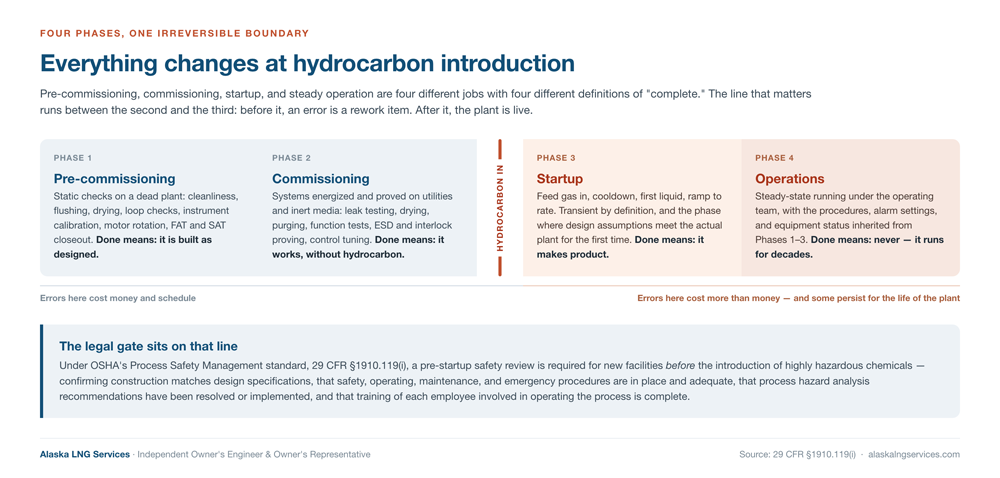
The pre-commissioning and commissioning distinction matters because each phase has a different definition of “complete,” and confusing them is how systems get declared ready on the strength of a test that proved something else.
Pre-commissioning is static work on a dead plant: cleanliness and flushing, drying, loop checks, instrument calibration, motor rotation checks, closing out factory and site acceptance tests (FAT and SAT). Complete means the plant is built as designed.
Commissioning energizes systems and proves them on utilities and inert media: leak testing, drying and purging, function testing, emergency shutdown (ESD) and interlock proving, control loop tuning. Complete means it works—without hydrocarbon in it.
Startup introduces feed gas, takes the plant through cooldown to first liquid, and ramps to rate. It is transient by definition, and it is the first time design assumptions meet the actual plant.
Operations is steady-state running by the operating team, using the procedures, alarm settings, and equipment status inherited from the three phases before it.
The boundary that governs everything is hydrocarbon introduction. Before it, an error is a rework item with a cost and a schedule impact. After it, the plant is live.
The Gate Is Not a Milestone, It Is a Legal Requirement
“Verifying operational readiness” has a specific meaning in U.S. regulation, and it is worth quoting rather than paraphrasing. Under OSHA’s Process Safety Management standard, 29 CFR §1910.119(i), an employer “shall perform a pre-startup safety review for new facilities and for modified facilities when the modification is significant enough to require a change in the process safety information.”
Before highly hazardous chemicals are introduced, that review must confirm four things:
- that “construction and equipment is in accordance with design specifications”;
- that “safety, operating, maintenance, and emergency procedures are in place and are adequate”;
- that for new facilities “a process hazard analysis has been performed and recommendations have been resolved or implemented before startup,” and that modified facilities meet management-of-change requirements;
- that “training of each employee involved in operating a process has been completed.”
Read those four in sequence and the intent is clear. The pre-startup safety review is not a signature on a schedule. It is the point at which someone must be able to demonstrate that the plant, the paperwork, and the people are all simultaneously ready—and it is where the commissioning-to-operations handover is supposed to be closed out.
Nothing Temporary Stays Temporary On Its Own
The most consequential commissioning failures are not dramatic. They are the ordinary artifacts of getting a new plant running, left in place after the reason for them expired:
- Alarm and trip settings widened for commissioning and never re-based to operating values.
- Bypasses, overrides, and jumpers placed under control during proving, where the register only works if someone owns closing it out line by line.
- Car seals and valve position control set for commissioning states, with the seal program and its verification lagging behind.
- Temporary strainers, spades, and spool pieces installed for flushing, each needing a documented removal rather than a remembered one.
- Procedures written for a plant nobody had run yet, including steps that allow operator discretion because the correct value was not yet known.
- As-built drift—field changes made under commissioning pressure that never reached the P&IDs, the model, or the process hazard analysis.
None of these is a mistake at the time it is made. Each is a normal, necessary part of commissioning. The failure mode is entirely in the handover.
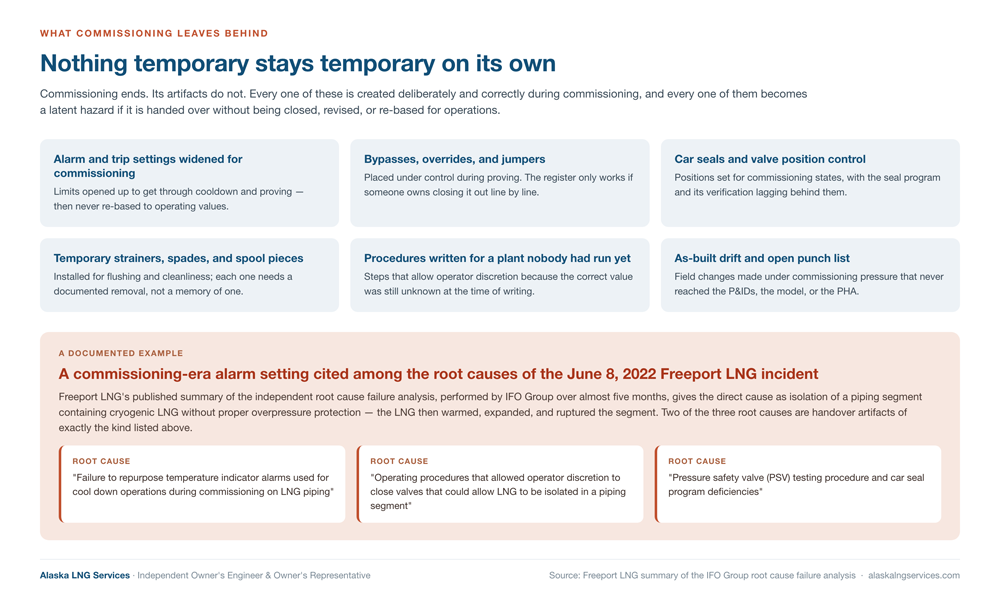
There is a well-documented illustration of exactly this. In its published summary of the independent root cause failure analysis of the June 8, 2022 incident, performed by IFO Group over almost five months, Freeport LNG gives the direct cause as “isolation of a piping segment containing cryogenic liquefied natural gas (LNG) without proper overpressure protection,” which then warmed, expanded, and ruptured the segment. Among the listed root causes are “failure to repurpose temperature indicator alarms used for cool down operations during commissioning on LNG piping,” “operating procedures that allowed operator discretion to close valves that could allow LNG to be isolated in a piping segment,” and “pressure safety valve (PSV) testing procedure and car seal program deficiencies.”
A commissioning-era alarm configuration, a procedure written with discretion in it, and a valve-position control program—three handover artifacts, cited as root causes of an incident that occurred long after the plant had been running. Whatever else that case demonstrates, it demonstrates that the commissioning-to-operations seam is a real place where hazards live, not a paperwork exercise.
Coordination Is the Other Half of the Job
The second thing independent oversight is for is coordination across systems that are commissioned by different teams on different schedules but operate as one plant.
Process, controls, utilities, and marine each have their own commissioning logic, and each will happily declare completion inside its own boundary. The interactions between them are what actually determine whether the plant can start: control system behavior against the process’s real dynamics, utility availability and reliability at the moment a system needs it, ESD hierarchy and cause-and-effect across system boundaries, and—on an export facility—the marine systems that must be ready for the first cargo on a schedule that nobody controls. That work sits across our process, controls, and utility systems engineering and marine systems and ship-to-shore commissioning scopes, and it is where the interfaces get owned rather than assumed.
Sequencing constraints compound the problem where the calendar is short. On cold-climate projects, commissioning competes with construction for the same access—the subject of our post on Arctic commissioning constraints. And on marine facilities, survey and certification lead times have to be set against fabrication and delivery well before anyone is thinking about first cargo, which is where statutory and class certification lead times start driving other dates.
What Independent Oversight Is Actually For
Owner-side oversight during this phase is not a second opinion on the contractor’s work. It is a defined set of tasks with an owner’s interest behind them:
- Verifying system completeness against the design basis before hydrocarbon introduction—not against the contractor’s completion certificate.
- Testing procedures against field conditions, on the plant as built rather than as drawn.
- Owning the temporary-to-permanent register—every widened setting, bypass, car seal, and temporary item tracked to a documented close-out.
- Confirming the pre-startup safety review has substance behind each of its four confirmations, rather than signatures.
- Holding the interfaces between process, controls, utilities, and marine, where each discipline’s completion stops at its own boundary.
- Making the handover a deliverable—the operating team receives a plant whose settings, procedures, and drawings describe what is actually installed.
The contractor’s interest is mechanical completion and demobilization. The operator’s interest is a plant that runs for thirty years. Those are not the same interest, and the gap between them is precisely the commissioning-to-operations seam. Independent field engineering and technician support exists to hold that seam on the owner’s behalf.
Alaska LNG Services provides independent Owner’s Engineer and Owner’s Representative services across process plant and marine LNG facilities — Alaska LNG engineering consulting that is independent of the contractor delivering the plant — through commissioning, startup, and operational readiness. Contact us to discuss your project.
Frequently Asked Questions
What is the difference between pre-commissioning and commissioning?
Pre-commissioning is static work on a plant that is not energized—cleanliness and flushing, drying, loop checks, calibration, motor rotation, FAT and SAT closeout—and it is complete when the plant is built as designed. Commissioning energizes systems and proves them on utilities and inert media, through leak testing, purging, function tests, ESD and interlock proving, and control tuning. It is complete when the plant works without hydrocarbon in it. Startup is a third phase, beginning at hydrocarbon introduction.
What is a pre-startup safety review, and when is it required?
Under 29 CFR §1910.119(i), a pre-startup safety review is required for new facilities, and for modified facilities where the modification is significant enough to require a change in the process safety information. Before highly hazardous chemicals are introduced it must confirm that construction and equipment match design specifications, that safety, operating, maintenance, and emergency procedures are in place and adequate, that process hazard analysis recommendations have been resolved or implemented, and that training of every employee involved in operating the process is complete.
Why does the commissioning-to-operations handover matter so much?
Because commissioning necessarily creates temporary conditions—widened alarm and trip settings, bypasses and overrides, car-sealed valve positions, temporary strainers and spades, procedures written before anyone had run the plant. Each is correct while commissioning is underway and hazardous once it is not. Freeport LNG’s published root cause summary for its June 8, 2022 incident lists a failure to repurpose commissioning-era temperature indicator alarms among the root causes, years after startup.
What should independent oversight actually deliver during startup?
Verification of system completeness against the design basis rather than a completion certificate; procedures tested against the plant as built; a temporary-to-permanent register tracked to documented close-out; substance behind each confirmation in the pre-startup safety review; ownership of the interfaces between process, controls, utilities, and marine; and a handover in which settings, procedures, and drawings describe what is actually installed.
You can learn more in our Alaska LNG engineering articles.
About the author: David Moras writes on LNG commissioning, startup, and operational readiness for Alaska LNG Services LLC, an independent Owner’s Engineer and Owner’s Representative firm serving process plant and marine LNG projects.