

Arctic LNG Projects: Engineering and Operational Considerations
Arctic LNG Projects: The Calendar Is the Constraint, Not the Cold
Arctic LNG projects are usually described as a temperature problem. In execution they are a calendar problem. The cold is knowable and can be engineered against; the season is fixed, short, and indifferent to the schedule. That is the difference an owner feels, and it is where Arctic experience actually pays.
Extreme cold does drive real engineering: material toughness, winterization, instrumentation behavior, marine access. But every one of those items has a known answer. What has no answer is a construction window that opened late and closes anyway.
The Ground Decides When You Build
On Alaska’s North Slope, heavy off-road work does not begin when the schedule says so. It begins when the Alaska Department of Natural Resources (DNR) opens the tundra. Under the DNR’s published criteria, the coastal areas open to winter off-road travel when soil temperature at a depth of 12 inches reaches 23°F and there is an average of six inches of snow on the ground; in the Brooks Range foothills the snow requirement is nine inches. The date that condition is met has ranged from as early as November 2 to as late as January 27.
That is an eleven-week spread in the start of the heavy-haul season, and the far end of the season does not move to compensate. When thawing conditions arrive, winter travel is closed and operators are given 72 hours to move vehicles and equipment off the tundra. From break-up until July 15, no off-road travel is permitted at all except in true emergencies. Summer work is limited to vehicles individually tested and approved by DNR, in the exact configuration and payload tested.
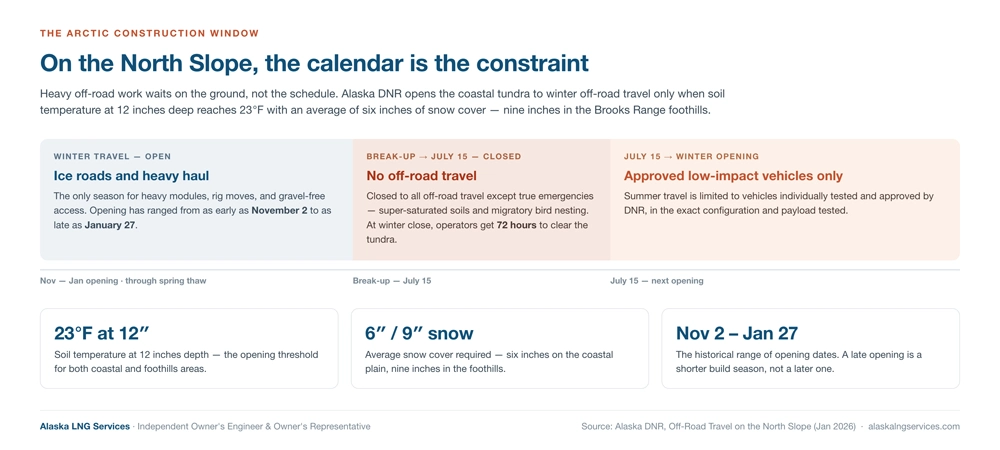
For an owner, that changes what a schedule risk looks like. A three-week slip in module fabrication is a three-week slip in Louisiana. On the Slope, if it pushes a heavy lift past the close of winter travel, it is a one-year slip. This is why Arctic execution planning is done backward from the window—module sizing, laydown, sequencing, and long-lead procurement all resolve to the same question: does it land inside the season, and what happens if the season opens on January 27?
Cryogenic by Design Is Not the Same as Cold by Exposure
The most common misreading of Arctic LNG is that an LNG plant is already a cold plant, so cold climate is not a new problem. LNG is stored at roughly −260°F, so the cryogenic side of the facility is engineered for temperatures far below anything the weather will produce.
But the systems designed for cryogenic service are not the systems the weather reaches. Ambient cold is an environmental load applied to everything outside the process envelope—instrument air and impulse lines, firewater and drains, hydraulics and lube oil, analyzers and heat tracing, structural steel, lifting equipment, diesel and emergency power. None of those are made cold-tough by an LNG process design basis.
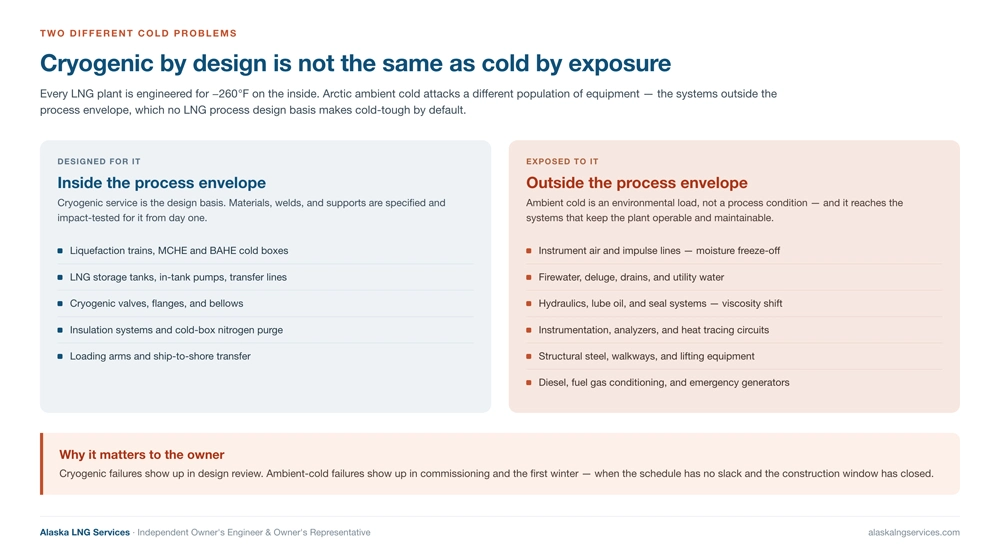
The consequence is a scheduling asymmetry, not just a technical one. Cryogenic material selection is settled in design review, where it is cheap to get right—brittle fracture risk, minimum design metal temperature, impact-testing requirements, and weld procedures are all resolved on paper. Ambient-cold failures are found in commissioning and the first winter, when the construction window has closed and there is nowhere left to absorb them.
For onshore U.S. facilities, the regulatory floor sits under all of this: 49 CFR §193.2301 requires that each LNG facility constructed after March 31, 2000 comply with Part 193 and with NFPA 59A-2001. Cold-climate design decisions are made on top of that baseline, not instead of it—an area our Arctic and cold-climate LNG engineering scope covers directly.
Winterization Is a Utilities Problem Before It Is a Process Problem
Winterization gets written into project scopes as insulation and heat tracing. In practice, the failures that stop an Arctic plant are utility and instrumentation failures: a moisture carryover that freezes an impulse line and takes a transmitter with it, a heat trace circuit that was commissioned but never proved under load, a drain that holds water, a hydraulic system that will not stroke a valve at design ambient.
The engineering test for winterization is not whether a system survives the cold. It is whether a system can still be operated and maintained in the cold—whether a technician can reach it, whether it can be isolated and drained without freezing something else, whether it can be worked on outdoors in the dark. That question belongs in design review, where it is a drawing comment, rather than in the first winter, where it is a callout.
Commissioning in a Season That Does Not Extend
Commissioning is where Arctic constraints compound. Instrumentation accuracy, mechanical tolerances, and system response all shift in extreme ambient cold, so loop checks, FAT and SAT results, and functional tests carried out in one season may not represent behavior in another. Cooldown and startup sequences need more conservative holds. Multidisciplinary teams need to be resourced and mobilized inside the same window that construction is competing for.
The practical result is that Arctic commissioning has to be planned as a season, not a phase. Systems get sequenced so that anything requiring heavy access is proven while access exists, and anything that can be completed under cover is deferred. That sequencing decision is made months before it takes effect, in design review and execution planning—which is the argument for commissioning and startup oversight that starts well upstream of commissioning, backed by the field engineering and commissioning support to carry it out on site.
Marine Access Has Its Own Rulebook and Its Own Season
Arctic marine operations add a second calendar and a second regulatory frame. Ice conditions, extreme weather, and remote logistics govern LNG carrier movements, jetty and mooring design, and ship-to-shore interfaces.
Vessels operating in polar waters fall under the International Code for Ships Operating in Polar Waters (Polar Code), which entered into force on 1 January 2017 and is mandatory under both SOLAS and MARPOL. It covers ship structure, stability, machinery, watertight integrity, navigation, voyage planning, communications, crew training under STCW, and pollution prevention. Ships must hold a Polar Ship Certificate classifying them as Category A, B, or C by ice capability, and carry a Polar Water Operational Manual documenting operational limitations.
For a terminal owner, that certificate and that manual are not the shipowner’s paperwork. They are the boundary conditions on who can call, in what ice, at what time of year—which feeds directly back into terminal design, berth availability assumptions, and the commercial model. It sits alongside the statutory and classification requirements that govern the facility itself, and it is where marine LNG and terminal engineering and process-plant engineering have to be read together rather than in sequence.
What Arctic Experience Actually Buys
Arctic experience is often sold as familiarity with cold. What it really provides is an accurate sense of which decisions are reversible. In a temperate project, most execution errors cost money and time. In an Arctic project, a meaningful share of them cost a year, because the correction cannot be made until the window reopens.
An owner’s engineer with cold-climate execution history is looking for those specific decisions early, while they are still cheap to change.
| The Arctic decision | When it stops being reversible |
|---|---|
| Module sizing and the heavy-lift plan | At the close of winter off-road travel — the next chance is next season |
| Long-lead procurement and delivery-to-site dates | At the season’s last haul, regardless of when the equipment is ready |
| Winterization scope, judged on operability rather than survival | At commissioning, when a technician has to work on it outdoors |
| Commissioning sequence against available access | Once construction has consumed the access the two phases share |
| Ice class, Polar Code certification, and berth availability assumptions | At vessel selection and terminal design freeze |
Independent, owner-side review of those items, before they are locked, is where LNG project consulting in Alaska earn their place on a project.
Alaska LNG Services provides independent Owner’s Engineer and Owner’s Representative services across process plant and marine LNG facilities, including Arctic and cold-climate developments. Contact us to discuss your project.
Frequently Asked Questions
Isn’t an LNG plant already designed for cold?
The process side is. LNG is stored at roughly −260°F, and everything in cryogenic service is specified and impact-tested for it. Arctic ambient cold reaches a different population of equipment—instrument air, firewater and drains, hydraulics and lube oil, analyzers and heat tracing, structural steel and lifting gear—none of which an LNG process design basis makes cold-tough by default.
When can you actually build on Alaska’s North Slope?
Heavy off-road work requires the Alaska DNR to open the tundra to winter travel, which happens when soil temperature at 12 inches deep reaches 23°F with an average of six inches of snow cover (nine inches in the foothills). Opening dates have ranged from November 2 to January 27. From break-up until July 15 no off-road travel is permitted except in emergencies, and summer travel is limited to DNR-tested vehicles.
What makes Arctic commissioning different?
Extreme ambient cold shifts instrumentation accuracy, mechanical tolerances, and system response, so results from one season may not represent another. The larger constraint is access: commissioning competes with construction for the same short window, so systems have to be sequenced so anything needing heavy access is proven while access exists.
What does the Polar Code require of vessels serving an Arctic LNG terminal?
The Polar Code entered into force on 1 January 2017 and is mandatory under SOLAS and MARPOL. It covers ship structure, stability, machinery, navigation, voyage planning, crew training, and pollution prevention. Vessels need a Polar Ship Certificate—Category A, B, or C by ice capability—and a Polar Water Operational Manual stating operational limitations. For the terminal owner those documents define who can call, in what ice, and when.
You can learn more in our Alaska LNG engineering articles.
About the author: David Moras writes on Arctic and cold-climate LNG execution for Alaska LNG Services LLC, an independent Owner’s Engineer and Owner’s Representative firm serving process plant and marine LNG projects.