LNG Project Development: Why Success Is Decided Long Before Start-Up
LNG project development rarely struggles because of technology; it struggles because of decisions made during design, construction, commissioning, and start-up, often years before first gas flows. That is the consistent lesson the engineers at Alaska LNG Services LLC have taken from careers spanning liquefied natural gas (LNG), cryogenic facilities, oil and gas, chemical, air separation (ASU), and power generation projects worldwide.
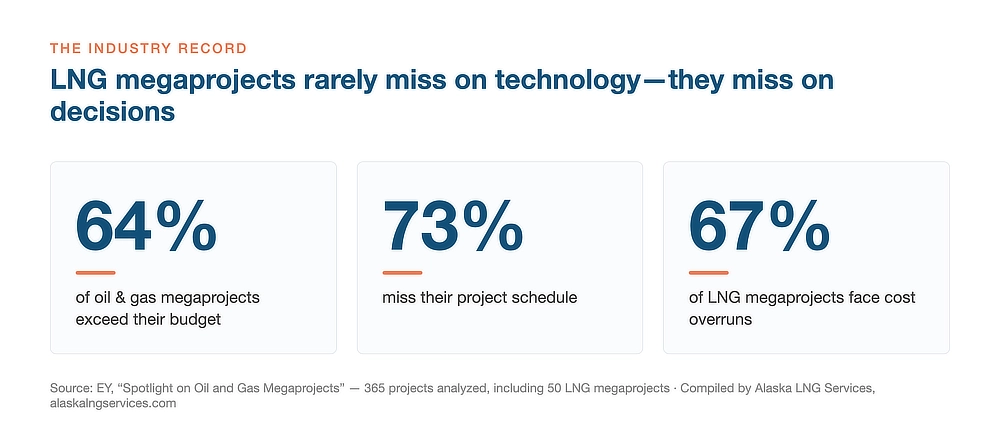
Most major LNG facilities are built on proven liquefaction technology. Yet some plants reach reliable production within weeks of start-up, while others spend months—or years—resolving problems that could have been prevented. The industry record bears this out: EY’s analysis of 365 oil and gas megaprojects found 64% exceeding budget and 73% missing schedule, with costs escalating an average of 59% above initial estimates—and among the 50 LNG megaprojects in that sample, 67% faced cost overruns and 68% experienced schedule delays.
The difference between the projects that succeed and the ones that struggle is rarely the technology license. It is experience: knowing which early decisions will resurface later as commissioning delays, production bottlenecks, or reliability problems, and correcting them while they are still inexpensive to correct.
Where LNG Projects Actually Go Wrong
By the time feed gas enters the plant, most of the opportunities to avoid delay have already passed. The problems that surface during commissioning and start-up usually originate much earlier, in decisions made during design and construction:
| The decision made early | How it surfaces at start-up |
|---|---|
| Process design optimized on paper, not for operations | Operating flexibility constraints; plant runs below design rates |
| Control philosophy set before operations input | Distributed control system (DCS) logic misaligned with how operators actually run the plant; extended tuning |
| Equipment selected on capital cost | Reliability problems and unplanned downtime across the plant’s life |
| Constructability not challenged during design | Field rework, schedule slip, and quality escapes during construction |
| Operational readiness left as a late checklist | Untrained teams and missing procedures when first gas arrives |
| Commissioning planned after mechanical completion | Sequence conflicts, idle crews, and months added to start-up |
| EPC-to-operations knowledge transfer started late | Design intent lost; problems rediscovered—and re-solved—by operations |
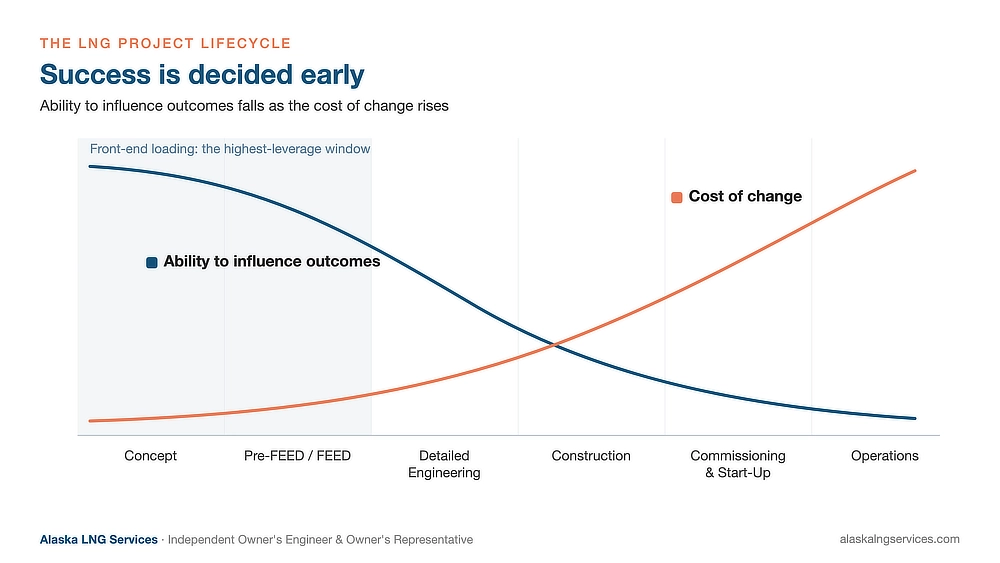
This is not only field experience—it is the most consistently documented finding in capital-projects research. Independent Project Analysis (IPA) research across more than 25,000 capital projects shows that the completeness of front-end loading (FEL)—how well a project is defined before execution—is the single best predictor of its safety, cost, schedule, and operability outcomes.
Small engineering decisions have saved months during commissioning. Seemingly minor compromises have become expensive, permanent production constraints. The distinction between the two is almost never visible in a design review meeting—it is visible to people who have started plants up and lived with the results.
The Alaska and North American Context
Most LNG export facilities in the Lower 48 United States receive feed gas from established interstate pipeline networks. Internationally, many plants are integrated directly with upstream gas production. Alaska is a distinct case: Alaska’s proved natural gas reserves reached 103 trillion cubic feet (Tcf) in 2024, per the U.S. Energy Information Administration (EIA), and the proposed Alaska LNG Project would move North Slope gas—anchored by roughly 40 Tcf of reserves in the Prudhoe Bay and Point Thomson units—south through an 807-mile pipeline from Prudhoe Bay to a 20-million-tonne-per-annum (MTPA) liquefaction facility at Nikiski, while also supplying existing and standby LNG infrastructure along the route.
Projects of this scale come to fruition through long-term investors—the developers whose early commitment creates a generation or more of production, supply contracts, and downstream opportunity. Those investors carry the largest exposure to the early technical decisions described above, and they are the reason independent, owner-side technical oversight exists as a discipline.
What Independent Oversight Covers Across the Lifecycle
Independent LNG engineering services exist to protect the owner’s investment from concept through operations—through client-side assurance and verification, or embedded within the owner’s own project team. Across the lifecycle, that oversight covers:
- Concept development and feasibility studies
- Pre-FEED and front-end engineering design (FEED)
- Detailed engineering review and design assurance
- Construction oversight
- Mechanical completion and pre-commissioning
- Commissioning and start-up support
- Operational readiness and performance testing
- Reliability improvement, debottlenecking, and brownfield expansions and modifications
The objective is not simply to complete construction. The objective is a safe, reliable start-up, design production reached quickly, and the plant’s return on investment (ROI) protected across its operating life.
The Technical Disciplines That Determine Outcomes
The decisions that shape an LNG project’s economics run through a handful of technical disciplines. Experienced specialist coverage in each is what converts design intent into operating performance:
- Marine LNG and ship-to-shore facilities
- Process engineering for LNG facilities
- Process control and automation
- Instrumentation and electrical engineering
- Rotating equipment—compressors, gas turbines, and turbomachinery
- Gas treatment and processing
- Cryogenic liquefaction, storage, and loading
The Owner’s Interest Comes First
Unlike an EPC contractor or an equipment vendor, an independent Owner’s Engineer has no equipment to sell and no construction schedule to defend—only the owner’s long-term interests: safety, regulatory compliance, operability, and lifecycle performance. For investors and developers evaluating LNG opportunities in Alaska or the wider United States, that independence is the mechanism by which hard-won project experience actually reaches the decisions where it matters.
Alaska LNG Services provides independent Owner’s Engineer and Owner’s Representative services across process plant and marine LNG facilities. Contact us to discuss your project.
Frequently Asked Questions
When should an LNG project owner bring on an Owner’s Engineer?
Before front-end engineering design (FEED) begins. The decisions with the largest influence on cost, schedule, and lifetime performance—process configuration, control philosophy, equipment selection—are made earliest, when changes are cheapest. Oversight added at construction can still verify quality, but it cannot recover options that were closed during design.
Why do LNG projects run late at start-up?
Most start-up delays trace back to earlier decisions: commissioning planned too late, operational readiness treated as an afterthought, control logic misaligned with operations, or knowledge lost in the handover between the EPC contractor and the operations team. The technology itself is rarely the constraint.
What is the difference between an Owner’s Engineer and an EPC contractor?
The EPC contractor is paid to deliver the facility; the Owner’s Engineer is paid to protect the owner’s interests while it is delivered. They are not adversaries—they simply represent different interests. The Owner’s Engineer reviews design, oversees construction, and verifies commissioning on the owner’s behalf, independent of the contractor’s schedule and commercial incentives.
What does debottlenecking mean for an LNG plant?
Debottlenecking is the process of identifying and removing the constraints that hold an operating plant below its potential capacity—whether in process design, rotating equipment, controls, or utilities. It is often the highest-return investment available on an existing facility, because the incremental production requires no new liquefaction train. A classic example: Woodside’s North West Shelf plant added roughly 8% capacity across three existing trains for A$48 million—completed on schedule and below budget—by resolving CO2-removal column foaming and upgrading refrigerant compressor turbines.
You can learn more in our Alaska LNG engineering articles.