
Case Study: Witnessing LNGC Sea Trials and Gas Trials & Proving a Newbuild Before Delivery
An LNG carrier is proven during sea trials and gas trials, not at the shipyard berth. Before a newbuild LNG carrier (LNGC) enters commercial service, every propulsion, cargo, auxiliary, and safety system must demonstrate—under witness—that it performs to the build specification and complies with the international rules the vessel will sail under. This case study from the careers of Alaska LNG Services LLC’s engineers shows what that acceptance process looks like from the owner’s side of the table.
The Assignment: The Owner’s Eyes at the Shipyard
A major North-East Asian shipowner appointed independent technical attendance for the sea trials and gas trials of a newbuild LNGC, ahead of delivery from the shipbuilder. The commercial stakes framed everything: the vessel was committed to a charterer under a long-term sale-and-purchase agreement with a European oil trader, so acceptance had to be both rigorous—no deficiency carried silently into service—and on schedule, because delivery timing fed directly into the charter obligations.
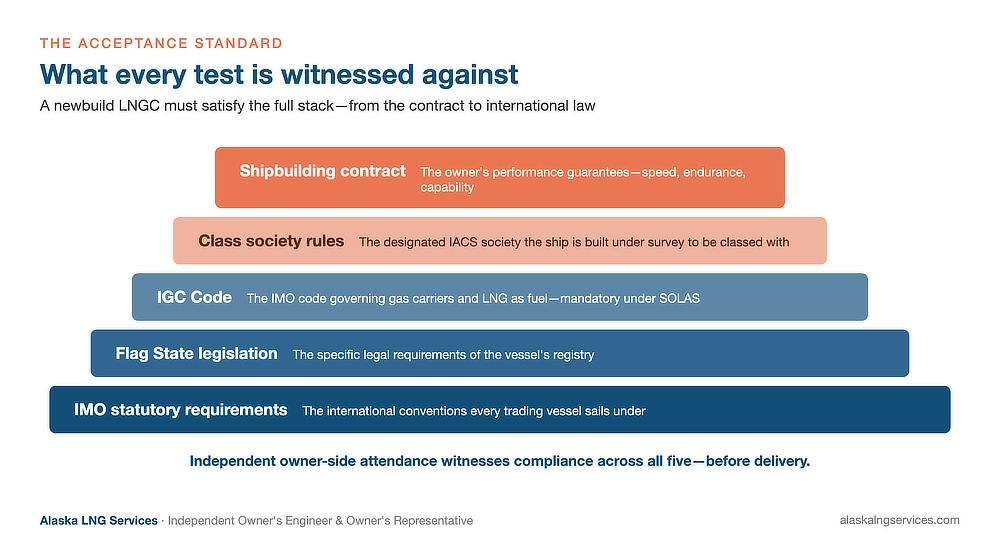
Every test was witnessed and assessed against the shipbuilding specification and the full regulatory stack: International Maritime Organization (IMO) statutory requirements, the specific Flag State’s legislation, and the rules of the designated IACS classification society the ship was designed and built under survey to be classed with.
Sea Trials: Proving the Ship
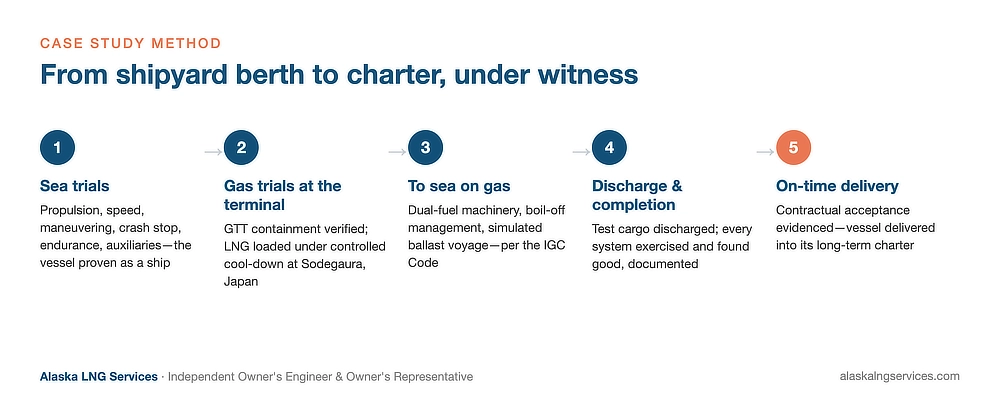
Sea trials confirmed the contractual performance guarantees for the vessel as a ship: main propulsion performance, maximum service speed, maneuverability including crash stop, endurance, steering, electrical generation and distribution, auxiliary machinery, navigation, automation and alarm systems, cargo handling equipment, and safety systems.
Gas Trials: Proving the Cargo System
Gas trials were conducted at the Sodegaura LNG Terminal in Japan. Before any cargo moved, the GTT membrane containment system—the technology at the heart of most modern LNGCs—was verified for integrity, along with its protection and monitoring systems. LNG was then loaded under controlled cool-down protocols, with cargo instrumentation, safety shutdown functions, and boil-off gas management verified through the operation.
To Sea on Gas: Dual-Fuel Under the IGC Code
With cargo aboard, the vessel proceeded to sea to operate all dual-fuel machinery in compliance with the International Code for the Construction and Equipment of Ships Carrying Liquefied Gases in Bulk (IGC Code)—mandatory under SOLAS since 1986—and the related IACS rules governing LNG as a marine fuel. Testing extended through simulated ballast-voyage transit, relief and flare systems, reliquefaction systems where fitted, and the operational transitions between propulsion modes, before returning to discharge the test cargo and complete trials.
A modern LNGC is a highly integrated system: propulsion, cargo handling, automation, safety systems, and containment technology interact continuously. The trials verify not only that each piece of equipment works, but that the ship works—as a system, on gas, at sea.
The Outcome—and Why Independent Witness Matters
All systems were exercised and found good, evidencing the contractual requirements between shipowner and shipbuilder—and the vessel delivered on time into its charter.
That is the quiet value of independent, owner-side attendance at trials: deficiencies surface before delivery, while the shipbuilder still owns them—not after, when rectification means off-hire time, claims, and a charterer waiting on a vessel. For LNG projects, where a single carrier’s availability feeds directly into supply-chain reliability, acceptance quality and delivery schedule are the same problem.
That work is the core of Alaska LNG Services’ LNG shipyard oversight, sits within the regulatory landscape of statutory and classification compliance for LNG marine systems, and connects to the terminal side through marine LNG ship-to-shore interfaces.
Alaska LNG Services provides independent Owner’s Engineer and Owner’s Representative services across process plant and marine LNG facilities. Contact us to discuss your project.
Frequently Asked Questions
What are gas trials on an LNG carrier?
Gas trials are the first operation of a newbuild LNGC’s cargo and fuel systems with actual LNG: containment system verification, cargo loading under controlled cool-down, and sea-going operation of the dual-fuel machinery on boil-off gas. They follow sea trials and are the final proof, before delivery, that the vessel works as an integrated LNG system—not just as a ship.
What is the difference between sea trials and gas trials?
Sea trials prove the vessel as a ship—propulsion, speed, maneuverability, endurance, steering, electrical, and auxiliary systems—typically before any LNG is involved. Gas trials prove the vessel as an LNG carrier: containment integrity, cargo operations, and dual-fuel machinery operating on gas, witnessed against the IGC Code and class rules.
What is the IGC Code?
The International Code for the Construction and Equipment of Ships Carrying Liquefied Gases in Bulk—the IMO standard, mandatory under SOLAS since July 1986, prescribing the design, construction, and equipment requirements for ships carrying liquefied gases. For a newbuild LNGC, gas trials are where compliance stops being a design claim and becomes demonstrated operation.
What is a GTT membrane containment system?
A cargo containment technology—developed by the French engineering company GTT—in which thin cryogenic membranes line the ship’s inner hull to contain LNG at approximately -163°C. Membrane systems equip most of the modern LNGC fleet, and verifying the containment system’s integrity and its protection and monitoring functions is a central objective of gas trials.
You can learn more in our Alaska LNG engineering articles.