Case Study: Proving a Marine Facility is Asbestos-Free for Importation
Many countries have stringent regulations against the use and importation of asbestos. e.g. Australia enforces a zero-tolerance ban on asbestos and any facility entering Australian waters must prove it is asbestos-free, not merely declare it. All forms of asbestos have been banned in Australia since December 31, 2003—import, manufacture, use, and sale—and at the border it is a strict-liability matter where supplier declarations alone may not be accepted as evidence. For an internationally built facility, that standard has teeth. This case study shows what proving it actually takes.
The Requirement: Zero Tolerance, Demonstrated
Before a facility can enter territorial waters and take up station, Government requirements demand independent verification that no asbestos is present in any installed or procured area or equipment across the facility—a “non-asbestos” categorization covering everything from major process modules to gaskets and fittings.
A facility built overseas cannot simply assert compliance. It must produce a body of independent technical evidence rigorous enough to satisfy government inspectors—before arrival.
Case Study: 2,960 Samples, 16,500 Documents
Sampling locations are determined by a structured risk assessment, focusing physical verification on the areas and equipment classes with the highest potential for asbestos-containing materials—imported gaskets, seals, insulation, and fittings being classic offenders.
| Program element | What it proved |
|---|---|
| Risk-based sampling plan | Coverage is representative and defensible—effort concentrated where asbestos risk is real |
| 2,960 physical core samples across the facility | Direct material evidence, not paperwork assurance |
| Review of more than 16,500 documents | Procurement and QA traceability across every supplier and package |
| Secure chain of custody on every sample | Evidence integrity from deck to laboratory—no sample could be questioned |
| Accredited laboratory | Results the authorities recognize |
| Independent third-party review | The methodology itself—not just the results—are independently verified |
Every sample is handled as hazardous material under chain-of-custody protocols until the laboratory proves it is inert. That is what zero tolerance means in practice: the burden of proof sits with the facility, sample by sample.
Certification—and Access
Following independent review of the sampling program, the risk-assessment approach, and the laboratory results, certification of a facility’s non-asbestos categorization is presented to Government inspectors on arrival in territorial waters.
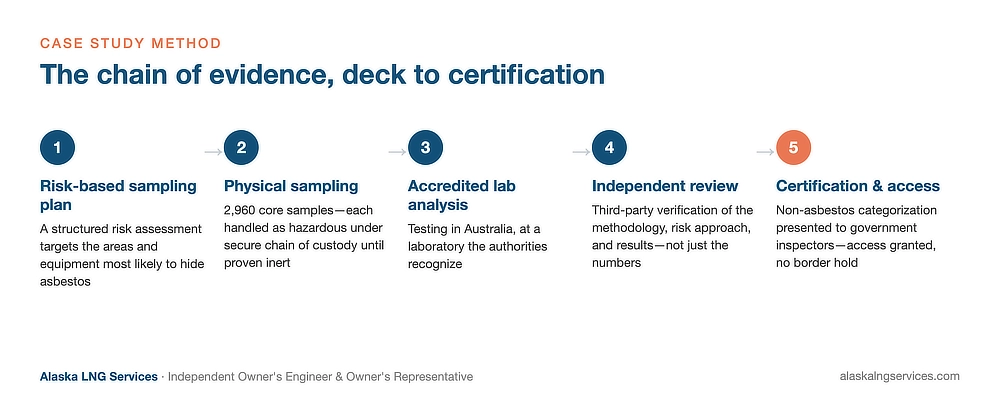
No re-sampling. No hold at the border. No schedule impact from compliance findings. The evidence is complete before inspectors ever step aboard.
Why This Matters for Project Owners
Regulatory verification is often treated as paperwork—until a facility or cargo is held at a border because a declaration could not be substantiated. e.g. Australia’s asbestos regime is the sharpest example: strict liability, zero tolerance, and a documented preference for laboratory evidence over supplier assurances. The same logic applies to any facility, module, or major equipment package procured internationally for a regulated destination.
The owner-side answer is the one this program demonstrates: define the evidentiary standard the regulator actually applies, verify with a risk-based physical program, keep the chain of custody unbroken, and have the methodology itself independently reviewed. Compliance stops being an assertion and becomes a record.
That verification discipline runs through Alaska LNG Services’ owner-side LNG engineering services, the shipyard and marine facility oversight where internationally procured equipment enters regulated jurisdictions, and the regulatory landscape covered in our article on statutory and classification requirements for LNG marine facilities.
Alaska LNG Services provides independent Owner’s Engineer and Owner’s Representative services across process plant and marine LNG facilities. Contact us to discuss your project.
Frequently Asked Questions
Are there regulations governing the use of asbestos?
Yes—completely. e.g in Australia, all forms of asbestos have been banned since December 31, 2003, covering import, manufacture, use, transport, storage, and sale. The ban is enforced at the border with a zero-tolerance, strict-liability approach: goods containing any trace of asbestos are prohibited imports. Similarly other OECD nations and territories also have regulatory framework in place to control the use of asbestos.
Why do internationally built facilities need asbestos verification before export?
Because a supplier’s declaration is not proof. e.g. Australian border authorities can require sampling by an independent competent person and testing at an accredited laboratory—at the owner’s expense—and goods found to contain asbestos are seized. For a marine facility, discovering a problem on arrival is a schedule and commercial catastrophe; verification before arrival is the only defensible strategy.
What is chain of custody, and why would every sample need it?
Chain of custody is the documented, secure handling of a sample from the moment it is taken to the moment it is analyzed—who held it, where, and under what seal. It makes the laboratory result legally and technically attributable to the exact sampling location. Without it, a clean result can be challenged; with it, the evidence stands.
What does an asbestos verification program for marine facility involve?
At this scale: a designated industrial hygienist per the destination country’s requirements, a risk assessment to target sampling, thousands of physical samples (2,960 on this case study), tens of thousands of procurement and QA documents reviewed (16,500+), accredited laboratory analysis, and independent third-party review of the entire methodology—so the certification presented to inspectors is backed by evidence at every level.
You can learn more in our Alaska LNG engineering articles.