Statutory and Classification Requirements for LNG Marine Facilities
Class Is Not Compliance: Statutory and Classification Requirements for LNG Marine Facilities
“In class with ABS” and “compliant” are not the same statement, and on LNG marine projects they are routinely used as if they were. Statutory requirements and classification requirements come from different authorities, are enforced by different parties, and fail in different ways. Only one of them can stop the asset from operating. The owner is the only party accountable to both.
That distinction is not academic. It determines who has actually approved what, which documents are worth anything in a dispute, and which gaps nobody is contractually obliged to close—which is where owner-side plan review earns its cost.
Two Authorities, Two Remedies
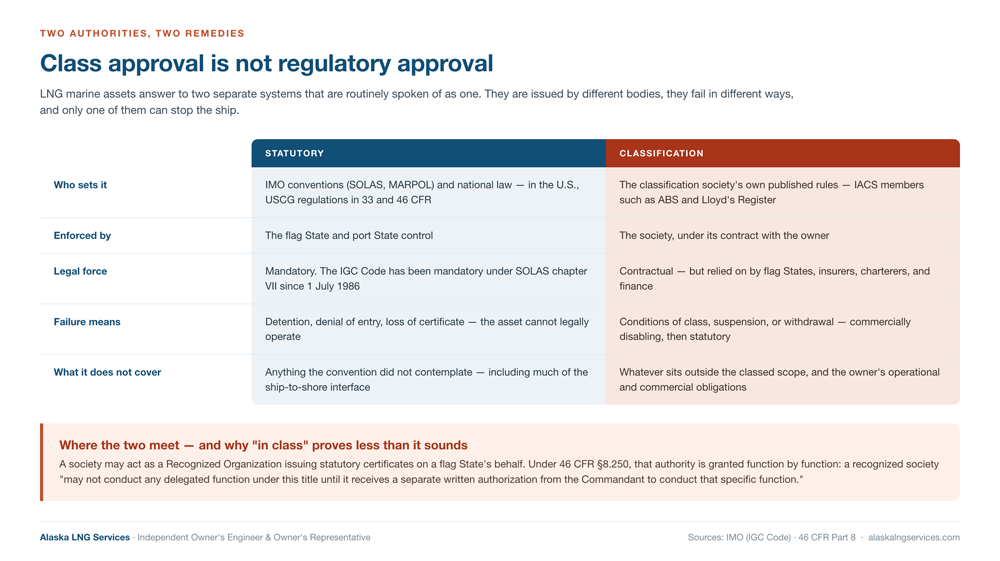
Statutory requirements are law. They originate in International Maritime Organization (IMO) conventions—principally the International Convention for the Safety of Life at Sea (SOLAS) and the International Convention for the Prevention of Pollution from Ships (MARPOL)—and in the national legislation that gives them force. For LNG carriers, the operative instrument is the International Code of the Construction and Equipment of Ships Carrying Liquefied Gases in Bulk (IGC Code), which has been mandatory under SOLAS chapter VII since 1 July 1986. Its stated aim is to prescribe design and construction standards, and the equipment ships should carry, “so as to minimize the risk to the ship, to its crew and to the environment.” Enforcement sits with the flag State and with port State control. Failure means detention or loss of certificate.
Classification requirements are contractual. A classification society—an International Association of Classification Societies (IACS) member such as the American Bureau of Shipping (ABS) or Lloyd’s Register (LR)—publishes its own rules and surveys the asset against them under a contract with the owner. Failure means conditions of class, suspension, or withdrawal. That is commercially disabling long before it is legally disabling, because insurers, charterers, and lenders all read class status.
Where the Two Meet — and Why “In Class” Proves Less Than It Sounds
The two systems intersect at the Recognized Organization. Flag States delegate statutory survey and certification work to classification societies, which is why a single society’s surveyor may attend a vessel wearing both hats in the same week.
What owners frequently miss is that the delegation is granular. Under the U.S. rules at 46 CFR Part 8, recognition is what allows a society “to become authorized to perform vessel inspection and certification functions delegated by the Coast Guard,” and §8.250 is explicit that a recognized society “may not conduct any delegated function under this title until it receives a separate written authorization from the Commandant to conduct that specific function.” Authorization is granted function by function, in writing.
So “we are with a recognized society” answers almost nothing on its own. The question that matters is which specific statutory functions that society is authorized to perform for this flag, on this asset, and which remain with the administration. That is a checkable fact, and it is worth checking before it is assumed in a schedule.
The U.S. Facility Clock Starts Earlier Than Most Schedules Assume
For the shore side of an LNG marine facility in the United States, the governing rules are the Coast Guard’s at 33 CFR Part 127, which apply to “the marine transfer area for LNG of each new waterfront facility handling LNG.”
The timing catches projects out. Under 33 CFR §127.007, an owner or operator intending to build a new facility handling LNG must submit a Letter of Intent (LOI) to the Captain of the Port (COTP) “no later than the date that the owner or operator files a pre-filing request with the Federal Energy Regulatory Commission (FERC)”—and at least one year prior to the start of construction. Both conditions apply. The LOI itself is substantive: owner and operator details, facility description, LNG vessel characteristics and frequency, and charts showing waterway channels within 25 kilometers of the facility. It is accompanied by a Waterway Suitability Assessment (WSA) in two stages—a Preliminary WSA covering port characterization and risk assessment, and a Follow-on WSA covering risk management strategies and the resources needed to execute them.
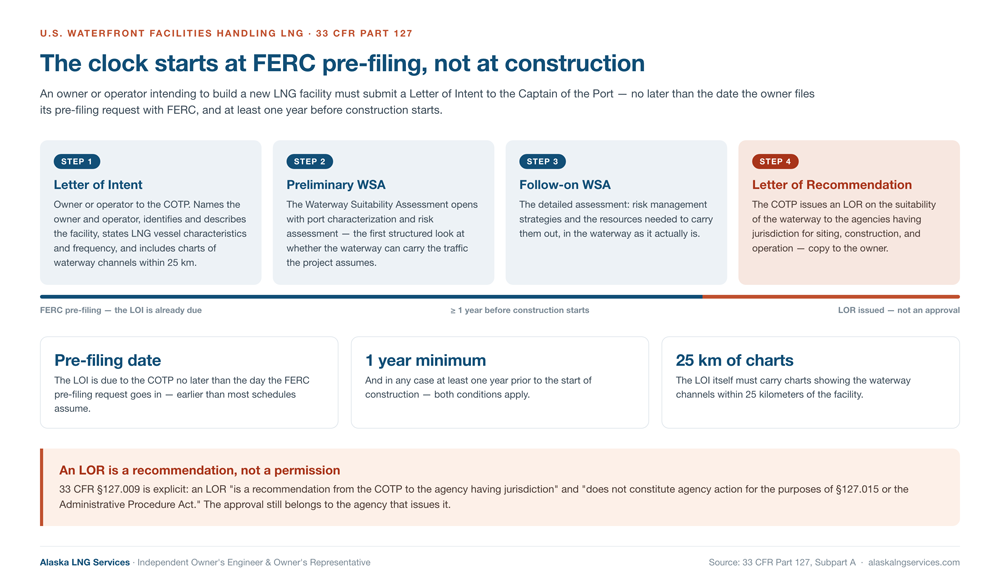
The output is a Letter of Recommendation (LOR), which the COTP issues on the suitability of the waterway for LNG marine traffic, addressed to the agencies having jurisdiction for siting, construction, and operation, with a copy to the owner.
And here the regulation says something worth reading twice. Under §127.009, an LOR “is a recommendation from the COTP to the agency having jurisdiction” and “does not constitute agency action for the purposes of §127.015 or the Administrative Procedure Act.” A favorable LOR is not an approval, and treating it as one in a project schedule is a category error of exactly the same kind as treating class certification as compliance.
The Gap Between the Two Is Where LNG Projects Actually Get Hurt
Both systems are mature, and each is thorough inside its own boundary. The problems concentrate where neither is squarely responsible.
The clearest example is the ship-to-shore interface. The vessel is certified under SOLAS and the IGC Code and classed by its society. The facility is regulated under 33 CFR Part 127 and built to onshore codes. The interface between them—mooring and berthing analysis against the actual design vessels, loading arm envelopes and emergency release, ESD hierarchy and the signals crossing the gangway, custody transfer, compatibility studies for every vessel intended to call—is governed by both regimes at once and owned outright by neither. Our post on ship-to-shore interface engineering goes through that boundary in detail.
The same pattern repeats at the process-to-marine boundary onshore, where terminal systems interface with liquefaction, storage, and utilities designed to a separate code family and reviewed by a separate discipline. It repeats again in cold-climate work, where ice class and Polar Code certification constrain berth availability in ways the commercial model may not have absorbed—the subject of our post on Arctic LNG project execution.
Nobody’s certificate covers the seam. The owner’s does not exist. So the seam is only closed if someone is specifically tasked with closing it.
What Owner’s Representative Plan Review Actually Does
This is the case for structured, owner-side plan review, and it is a narrower job than “compliance support.” Done properly it establishes, in writing and early:
- Which regime governs each system, and where a system answers to both.
- Which body approves what—flag State, port State, COTP, FERC, the classification society acting under its own rules, and the classification society acting as a Recognized Organization under a specific written authorization.
- The document set each approval actually produces, and what each document does and does not certify.
- The dates that drive other dates—the LOI at FERC pre-filing, the one-year-before-construction floor, survey and certification lead times set against fabrication and delivery.
- The interfaces nobody owns, assigned to someone by name.
Every item on that list is cheap to resolve in design review and expensive to resolve during construction, commissioning, or a port State inspection. That is the whole economic argument for Owner’s Representative plan review—not that it finds errors others miss, but that it finds them while they are still drawing revisions.
Alaska LNG Services provides independent Owner’s Engineer and Owner’s Representative services across process plant and marine LNG facilities, including statutory and classification interface management. Contact us to discuss your project.
Frequently Asked Questions
What is the difference between statutory and classification requirements?
Statutory requirements are law—IMO conventions such as SOLAS and MARPOL, given force by national legislation and enforced by the flag State and port State control. Classification requirements are the published rules of a classification society, surveyed under contract with the owner. Statutory failure can stop the asset from operating legally; class failure withdraws class, which disables it commercially through insurers, charterers, and lenders.
Does being in class mean a vessel is compliant?
No. Class certifies conformity with the society’s own rules. A society may also issue statutory certificates as a Recognized Organization on a flag State’s behalf, but under 46 CFR §8.250 it may not conduct any delegated function until it has separate written authorization from the Commandant for that specific function. Which statutory functions a society is authorized to perform is a specific, checkable fact, not an assumption.
When must a U.S. LNG facility submit its Letter of Intent to the Coast Guard?
Under 33 CFR §127.007, no later than the date the owner or operator files its pre-filing request with FERC, and at least one year before construction starts. It is submitted to the Captain of the Port with a Waterway Suitability Assessment—a Preliminary WSA and a Follow-on WSA.
Is a Letter of Recommendation an approval to build?
No. Section 127.009 states that an LOR is a recommendation from the COTP to the agency having jurisdiction and does not constitute agency action for the purposes of §127.015 or the Administrative Procedure Act. The approval remains with the agency responsible for siting, construction, and operation.
You can learn more in our Alaska LNG engineering articles.
About the author: David Moras writes on statutory and classification requirements for LNG marine assets at Alaska LNG Services LLC, an independent Owner’s Engineer and Owner’s Representative firm serving process plant and marine LNG projects.